kubernetesciliumnetwork-policysecuritykubeaidopensource
Cilium Network Policy Anti-Patterns We Learned the Hard Way

12 Aug 2026 · 16 min read
Introduction
I'm Shubham, an SRE at Obmondo. I'm a Certified Kubernetes Administrator, I contribute to CNCF projects, and I help maintain KubeAid and KubeAid CLI.
We wanted infrastructure where only the traffic that should be allowed is allowed, and we wanted that for our open source users too, not just for the clusters we run ourselves. So we built KubeAid-addons: a centralized, opinionated Helm chart that firewalls applications behind a toggle, following GitOps principles. You set global.netpol.enabled, turn on the per-app switch, commit, and Argo CD applies it. (The application-level firewalls are open source and live here).
Building that meant writing CiliumNetworkPolicies for a lot of very different applications: databases managed by operators, apps that talk to external APIs, apps behind an ingress controller, apps with liveness probes, apps sharing a namespace with other apps that nobody was firewalling yet.
That's where all of this comes from. Every anti-pattern below is something that broke on us, usually silently, usually with YAML that looked completely correct.
Cilium in one breath
If you already know Cilium, skip ahead. If you don't, the short version.
Cilium is an eBPF-based networking, observability and security layer for Kubernetes. It replaces the traditional iptables-based CNI plus kube-proxy setup with an eBPF datapath.
The reason that matters is mechanical. In an iptables world, every Service and every policy gets translated into iptables rules, and the kernel evaluates those rules linearly, top to bottom, for every packet. With 5,000 Services and 10,000 Pods, kube-proxy can generate hundreds of thousands of rules, and every packet potentially walks a very long chain (For programmers reading this - that's O(n) time complexity). Rule updates are worse: a single Service change can force a resync of a large chunk of the ruleset.
Cilium compiles the same information into eBPF programs and BPF maps that live in the kernel. A BPF map is a kernel resident hash table, so instead of walking 10,000 rules the kernel does a hash lookup. (hi again programmers 👋, thats O(1) instead of O(n)). That's the performance story.
The part that actually matters for policy, though, isn't performance. Cilium didn't just reimplement iptables logic in eBPF, it changed the security model. Policy is not evaluated against IP addresses. Cilium computes a security identity from a pod's labels, every pod with the same relevant labels shares one identity, and the policy map is keyed on identity pairs: (source identity → destination identity, port, protocol).
Cilium also ships Hubble, which exports flow data as logs, metrics and a UI, because the eBPF programs are already inspecting every packet anyway. We'll use it later.
Why we use CiliumNetworkPolicy and not the Kubernetes native one
Native NetworkPolicy is L3/L4 only: IPs and ports. CiliumNetworkPolicy goes up to L7, so you can allow specific HTTP methods and paths, or gRPC services, or Kafka topics.
There's CiliumClusterwideNetworkPolicy for baseline policies that apply across the whole cluster. Native netpols are namespace-scoped, and so is the regular CiliumNetworkPolicy, but the clusterwide CRD gives you cluster wide enforcement.
Native netpols have no concept of hostnames at all, only CIDR. CNP can allow egress by domain name, resolved dynamically. That's toFQDNs, and it has its own trap, we will talk about it later.
Native netpols can only allow. CNP adds explicit deny, and deny always wins over allow in such cases:
apiVersion: cilium.io/v2
kind: CiliumNetworkPolicy
metadata:
  name: db-access
  namespace: production
spec:
  endpointSelector:
    matchLabels:
      app: database
  ingress:
    - fromEndpoints:
        - matchLabels:
            role: backend
  ingressDeny:
    - fromEndpoints:
        - matchLabels:
            role: untrusted-client
And native netpols can only reference pods and namespaces via selectors, or raw CIDR blocks. CNP gives you predefined entities: world, host, cluster, kube-apiserver, remote-node. Those come up constantly once you start writing real policies.
The anti-patterns
1. toServices with the Service port instead of the pod's targetPort
You write a rule allowing egress to a database Service. The Service exposes 5432. You write 5432. The traffic gets dropped.
egress:
  - toServices:
      - k8sService:
          serviceName: my-database
          namespace: my-namespace
    toPorts:
      - ports:
          - port: "5432"
The database here is fronted by pgbouncer, which listens on 6432. The Service exposes 5432 and targets 6432. Here's what actually happens to the packet:
- Pod A sends a request to the Service's ClusterIP on port 5432, because that's the only address it knows. It has no idea what Pod B's IP or port are.
- eBPF intercepts this at the host side of Pod A's veth. The program looks the Service up in the service map, picks Pod B as the backend, and rewrites the packet. Destination IP becomes Pod B's real IP. Destination port becomes 6432.
- eBPF resolves identities: Pod A's IP maps to Pod A's identity, Pod B's IP maps to Pod B's identity.
- It does the policy map lookup on the post-DNAT tuple: (Pod A identity → Pod B identity, port 6432, TCP).
Your rule says 5432. The lookup is for 6432. No match, packet dropped, and nothing in the policy tells you that. The DNAT already happened by the time the policy engine sees the packet, so toPorts under a toServices rule has to be the backend pod's real targetPort.
egress:
  - toServices:
      - k8sService:
          serviceName: my-database
          namespace: my-namespace
    toPorts:
      - ports:
          - port: "6432"
If Pod B also has an ingress policy, that gets checked separately on Pod B's side, with the same post-DNAT tuple.
2. Using toServices at all when a stable label exists
The port thing is fixable once you know about it. The bigger problem with toServices is that it pins your policy to whatever the Service happens to be named right now.
Rename the release, reinstall under a different name, and the Service this rule points at no longer exists. Cilium doesn't complain. The rule just stops matching anything, and you find out when an app starts timing out.
Operator-set labels don't move. CloudNativePG puts cnpg.io/cluster on every pod in a cluster, and that value is the cluster name, not the release name:
This sidesteps both problems at once. The label is stable across releases, and there's no Service or DNAT layer involved, so there's no port ambiguity to get wrong. toEndpoints also covers direct pod to pod connections that never go through the Service at all.
We default to toEndpoints everywhere in KubeAid now. toServices is the exception at some places.
3. Selecting on labels Cilium throws away
This one cost me an afternoon.
endpointSelector:
  matchLabels:
    statefulset.kubernetes.io/pod-name: oncall-pgsql-1
The label exists on the pod. kubectl get pod --show-labels shows it. The selector matches nothing.
Cilium maintains a list of label patterns that are excluded from identity calculation, and statefulset.kubernetes.io/pod-name is on it, along with pod-template-hash, controller-revision-hash, apps.kubernetes.io/pod-index, batch.kubernetes.io/controller-uid and a handful of others. you can check them here.
The reason the list exists is worth understanding, because it tells you which of your own labels are risky. Identity-based policy works by grouping pods. If Cilium computed identity from every label, then a Deployment with two replicas would produce two different identities, because pod-template-hash and per-pod names differ. Now write a toEndpoints rule against that Deployment: it would match one replica and not the other. That defeats the entire point of grouping by identity, and it also means every rollout churns identities across the cluster. So Cilium filters those patterns out before computing identity.
The consequence is that a selector written against an excluded label doesn't error, doesn't warn, and silently matches nothing.
# CORRECT
endpointSelector:
  matchLabels:
    cnpg.io/cluster: oncall-pgsql
    k8s:io.kubernetes.pod.namespace: my-namespace
One label shared by all replicas, one stable identity.
The exclusion list is configurable per cluster, so you can append your own patterns if you have labels that churn.
4. toFQDNs without an L7 DNS rule
You want a pod to reach example.com. You write:
# WRONG
egress:
  - toFQDNs:
      - matchName: example.com
    toPorts:
      - ports:
          - port: "443"
That is a complete, valid toFQDNs rule, and on its own it will never work.
Before the pod can connect to example.com, it has to resolve it. That DNS lookup is itself just network traffic, a UDP request on port 53 heading to CoreDNS.
Before that query leaves the pod's veth, eBPF checks one thing: does a policy selecting this pod have a rules.dns block covering this traffic? If yes, the query gets redirected into Cilium's DNS proxy instead of going straight to CoreDNS untouched. The proxy forwards the query to CoreDNS, gets the answer back, and because it's sitting in the middle of the conversation it sees that answer. It records the mapping: this IP belongs to example.com, and writes it into the FQDN cache.
The pod receives the DNS answer normally and connects to the IP. eBPF now checks the toFQDNs rule, looks up whether that IP is associated with example.com, finds the entry the proxy just wrote, and allows the connection.
Without a rules.dns block anywhere, that middle step never happens. Cilium never learns what the IP is, so the toFQDNs lookup has nothing to match against.
You get one of two symptoms, and the second one is the confusing one:
- Nothing allows DNS egress at all. The pod can't resolve.
curlexits 6, "could not resolve host". Annoying, but it points straight at DNS. - Something allows port 53 as plain L4, but no
rules.dns. DNS resolves perfectly. The pod gets a good IP. Then the connection to that IP is dropped by policy.curlexits 7. Everything about DNS looks healthy, which is exactly why this one eats an afternoon.
# CORRECT
egress:
  - toEndpoints:
      - matchLabels:
          k8s-app: kube-dns
          io.kubernetes.pod.namespace: kube-system
    toPorts:
      - ports:
          - port: "53"
            protocol: ANY
        rules:
          dns:
            - matchPattern: "*"
  - toFQDNs:
      - matchName: example.com
    toPorts:
      - ports:
          - port: "443"
            protocol: TCP
The rules.dns block does not have to live in the same policy object as toFQDNs. Policies selecting the same pod compose, so a namespace-wide default-deny carrying the DNS rule works fine and the per-app policy can hold nothing but toFQDNs. What matters is that some policy selecting this pod has the DNS rule.
I'd still put both in the same policy as a habit. Splitting them means your FQDN rule quietly depends on the default-deny actually being rendered for that namespace, and on the pod not being carved out of it. Those are real conditions that nothing validates, and when one of them isn't met the failure shows up in the app, not in the policy you'd think to look at.
To check whether interception is actually on for a pod, look for its endpoint in the proxy redirect list:
kubectl exec -n kube-system <cilium-pod> -c cilium-agent -- \
  cilium-dbg status -o json | jq -r '.proxy.redirects[] | select(.proxy|test("dns")) | .name'
No entry for your endpoint ID means the proxy was never turned on for it, and toFQDNs cannot work no matter how the rule is written.
5. Default-deny surprises
Apply any CiliumNetworkPolicy that selects a pod, and that pod flips from "enforcement: never" to default-deny. The moment a pod is selected by a policy for a direction, everything not explicitly allowed in that direction is denied.
It happens per direction, independently. A policy with only an ingress section flips ingress to default-deny (and leaves egress alone).
What that looks like in practice: DNS stops resolving, because you never allowed egress to kube-dns. Kubelet health probes get dropped, because probes originate from the node, which carries the host identity, not a pod identity, and your ingress rules only mention other apps. The container fails its liveness probe, gets killed, and you're staring at CrashLoopBackOff with an application that's actually running fine.
So don't write app rules first. This is the order that has always worked for me:
- Write a default-deny policy for the namespace, and allow DNS egress in that same policy. If the namespace has other apps you're not firewalling yet, use
NotInin the endpoint selector to carve them out. - If the app has probes, allow ingress from the kubelet. That's the
hostentity. - If the app talks to the Kubernetes API at runtime, allow egress to
kube-apiserver. Most apps don't. If your pod only consumes ConfigMaps and Secrets through mounts or env vars, kubelet does that on the pod's behalf: it watches the API server, pulls the data, and writes it to the node filesystem or injects it at pod start. The pod process never opens a TCP connection to the API server, so it needs no rule. You need this rule only when something inside the pod is programmatically calling the API with client-go or an SDK to GET, WATCH or PATCH resources. When you do need it, usetoEntities: [kube-apiserver]. - If the workload is managed by an operator, check whether the operator talks to the workload pod directly, not just to the API server about it. If it does, allow ingress from the operator. CloudNativePG does this, and the operator lives in its own namespace, so the selector needs the namespace label too.
- Roll out in audit mode first. Policy gets evaluated, nothing gets dropped, Hubble shows you what would have been dropped.
- Read Hubble. It will show you every flow the app actually makes, including the ones nobody documented.
- Then write the real app rules.
Here's the default-deny template from the KubeAid-addons chart:
{{- range $ns, $config := .Values.defaultDeny.namespaces }}
---
apiVersion: cilium.io/v2
kind: CiliumNetworkPolicy
metadata:
  name: default-deny
  namespace: {{ $ns }}
spec:
  endpointSelector:
  {{- if $config.excludedPods }}
    matchExpressions:
    {{- range $config.excludedPods }}
    {{- range $key, $value := . }}
    - key: {{ $key }}
      operator: NotIn
      values:
      - {{ $value }}
    {{- end }}
    {{- end }}
  {{- else }}
    {}
  {{- end }}

  enableDefaultDeny:
    egress: true
    ingress: true

  # Allow only DNS egress to kube-dns
  egress:
  - toEndpoints:
    - matchLabels:
        io.kubernetes.pod.namespace: kube-system
        k8s-app: kube-dns
    toPorts:
    - ports:
      - port: "53"
        protocol: UDP
      - port: "53"
        protocol: TCP
      rules:
        dns:
        - matchPattern: "*"
{{- end }}
Two things to notice. It ranges over a map of namespaces, so it renders exactly one default-deny per namespace and there's no way for a second one to be added to same ns. And an empty endpointSelector: {} selects every pod in that namespace, with excludedPods as the escape hatch for namespaces where we're only firewalling part of what's running.
6. Assuming LoadBalancer traffic is pre-authorized
Your pod is internet-facing behind a type: LoadBalancer Service. You write ingress rules for the in-cluster callers and ship it. External traffic gets dropped.
ingress:
  - fromEndpoints:
      - matchLabels:
          app: frontend
The Service being internet-facing grants nothing. Service DNAT and policy enforcement are two separate, sequential steps.
The policy engine sits on the host side of the receiving pod's veth. By the time the packet reaches it, the Service is out of the picture entirely. All policy sees is a source identity and a destination identity, and for anything originating outside the cluster that source identity is world. Your rule allows app: frontend. world isn't that. Dropped, immediately after a Service load-balancing step that succeeded perfectly.
ingress:
  - fromEndpoints:
      - matchLabels:
          app: frontend
  - fromEntities:
      - world
Policy doesn't know or care how traffic arrived. It only knows what identity it carries once it gets there.
7. Relabeling doesnt impact the established connections
Changing a pod's labels does recompute its Cilium identity, and that does trigger the endpoint to regenerate its policy. But already-established connections, the ones tracked in conntrack, aren't necessarily re-evaluated against the new policy instantly. Enforcement is largely applied at connection setup time.
I want to be careful here. Exact behavior is version and configuration dependent, Verify the behavior on your own cluster and version rather than assuming.
8. Death by a thousand netpols
This is the one I feel most strongly about, because it isn't a mechanism bug. It's an organizational one, and you can't fix it with better YAML.
Real namespaces aren't one app per namespace. A shared namespace like checkout might run multiple services. Every service owner bolts on their own CiliumNetworkPolicy whenever they need a new path open. No shared owner, no central review, and nothing forces them to coordinate, because policies only ever compose additively. Nobody's rule technically conflicts with anyone else's. They just keep piling up.
Then something breaks and debugging stops being "read the policy." It becomes "grep every CNP that selects this namespace and hope you find the one that's wrong." You can't reason about a pod's effective policy from any single file, because the effective policy is the union of every rule from every policy that happens to select it.
The fix is centralizing policy authoring under one roof. Thats one of the reasons why KubeAid-Addons is one centralized helm chart for all network policies we have (infact we have centralized our operator configs as well). So for us and our open source users, network policies for all addons live in one chart, so it can be easily read and and get rendered conditionally per namespace, one targeted policy per app.
But naive centralization has its own trap, If you generate a policy per app and each of those includes its own default-deny, you get several default-denies in a namespace, each written from the perspective of one app, each unaware of the others. That causes another problem.
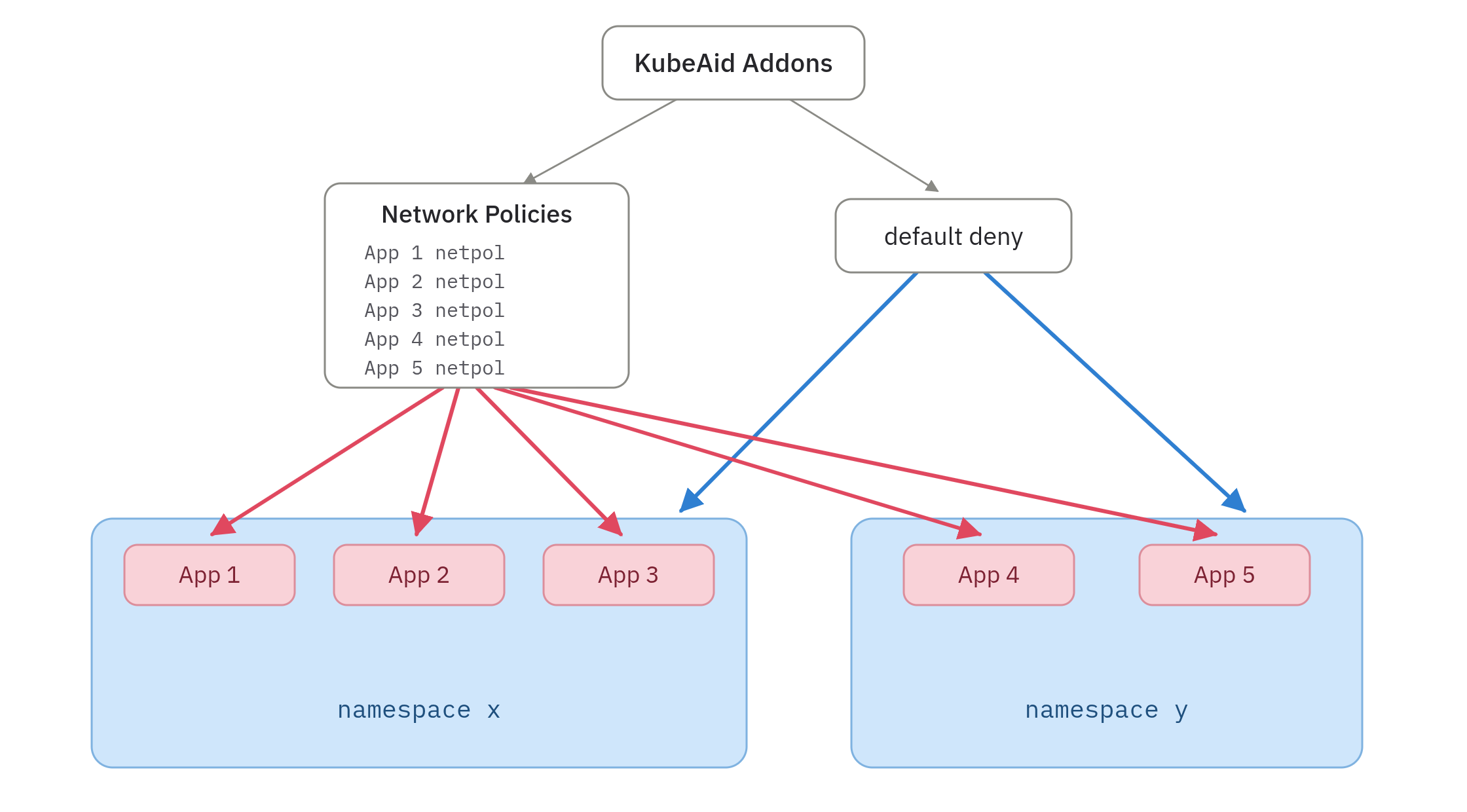
So the rule we follow is: one targeted policy per app, and exactly one default-deny per namespace, never one per app. The default-deny is a namespace-level concern. The app policies only ever add allows on top of it. Thats what we do in KubeAid-Addons. If you are firewalllling your applications and want an open source solution that can centrally store your cilium network policies - you can check out KubeAid and KubeAid-Addons and if you do that - please do give us your feedback over github issues - we would love to hear back. If you're doing this in your own clusters and hit something that isn't on this list, we'd like to hear about it on our github.
Ending notes and Links
- docs.cilium.io/en/stable/security/policy
- editor.networkpolicy.io for visualising a policy before you apply it
- KubeAid.io
- github.com/Obmondo/KubeAid (do give us a star 😉)
- here).
Thanks for your time :)