AI on your own servers
GPU nodes in your own cluster run the models. The NVIDIA GPU Operator installs the drivers, HAMi lets several workloads share one GPU and KEDA scales them. You bring the models, and they run on hardware you control.
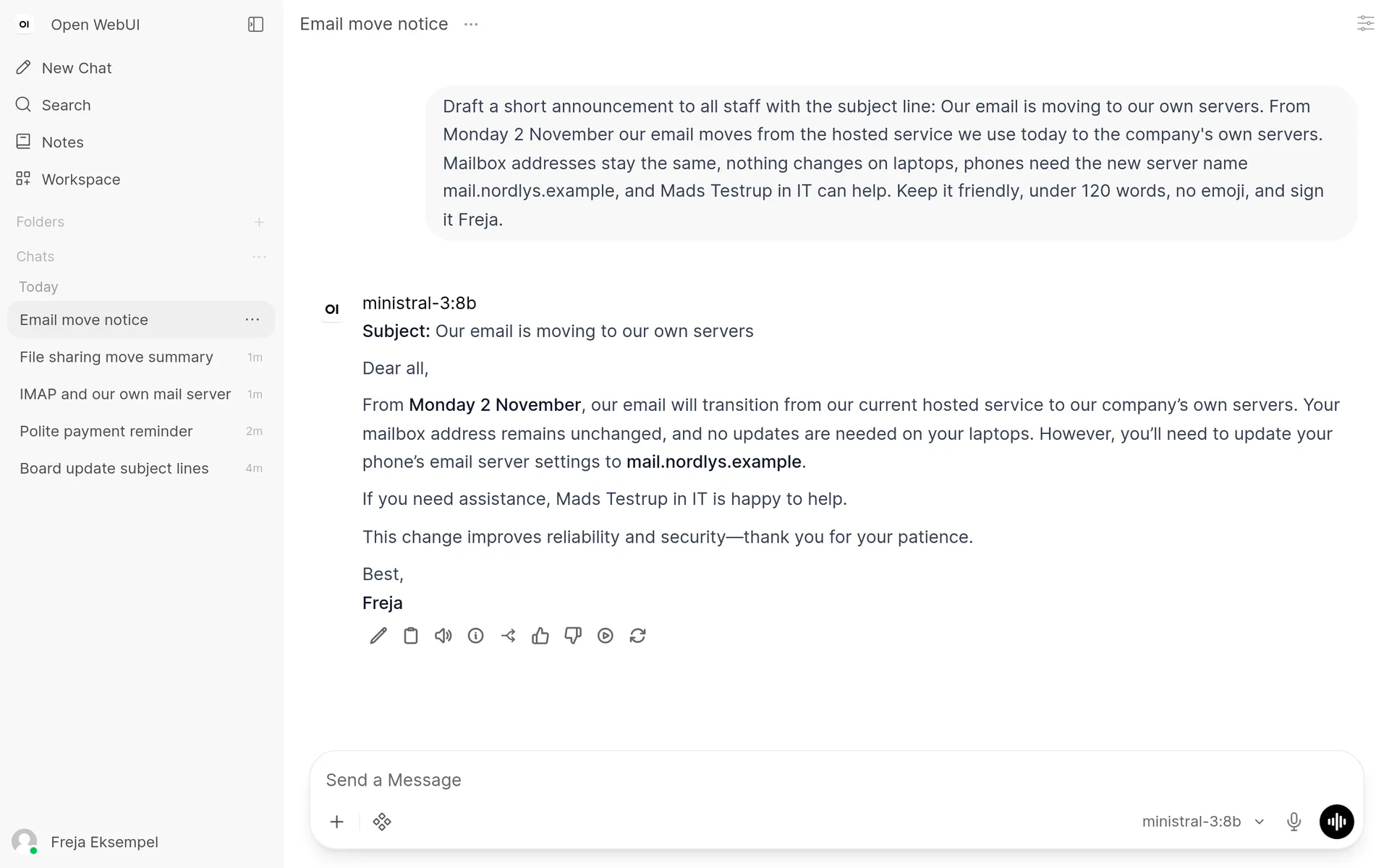
Screenshots are taken from the apps running on a test server, with made-up data.
What stays in your control
The model runs on GPU nodes in your own cluster, so prompts and documents stay on hardware you control.
Open-weight models are files you can download, run offline and keep a copy of. Fully open models, such as Apertus and OLMo, also publish their training data, so you can check how they were built.
The chat interface and the coding tools are separate programs that talk to your model, so you can swap any of them.
The licence decides what you may do with a model. Some open-weight models carry limits for EU companies or for large revenues. The table below lists them.
Open-source apps behind it
- NVIDIA GPU Operator
- HAMi
- KEDA
Alternative to
Closed AI assistants from non-EU vendors, such as ChatGPT, Microsoft Copilot, Google Gemini and Claude
Open-weight models you can run
Open-weight means the model files are published, so you can run them yourself. Open training data means the data is published too, so you can check how the model was built. The table was read from the model cards, licence files and vendor announcements on 2026-10-15.
- MistralMistral Large 3, Mistral Small 4, Mistral Medium 3.5
- Maker
- Mistral AI
- Country
- France
- Open training data
- No
- Licence
- Apache-2.0, Modified MIT
Large 3 and Small 4 are Apache-2.0. Medium 3.5 and Devstral 2 use a modified MIT licence that gives no rights to a company with global consolidated monthly revenue above USD 20 million. Large 4 was announced on 2026-10-06 and its licence is not stated yet. Mistral says the weights follow by the end of October.
- ApertusApertus 1.5 70B, Apertus 1.5 8B
- Maker
- EPFL, ETH Zurich, CSCS
- Country
- Switzerland
- Open training data
- Yes
- Licence
- Apache-2.0
Fully open: the weights, the training data and the full training details are published. Version 1.5 followed on 2026-07-24.
- EuroLLMEuroLLM-22B, EuroLLM-9B
- Maker
- IST Lisbon, Unbabel, University of Edinburgh et al.
- Country
- European Union
- Open training data
- Not confirmed
- Licence
- Apache-2.0
Built by European universities and companies and funded by the EU. Its model card calls it the best EU-made fully open model on general benchmarks. The multilingual web pre-training data (EuroWeb) and the instruction data (EuroBlocks) are public on Hugging Face. We have not confirmed that the rest of the training data is public.
- TeukenTeuken-7B-instruct-v0.6
- Maker
- OpenGPT-X: Fraunhofer, FZ Jülich, TU Dresden, DFKI
- Country
- Germany
- Open training data
- Not confirmed
- Licence
- CC-BY-NC-4.0, Apache-2.0
Built in Germany for 24 EU languages. The newest release, Teuken-7B-instruct-v0.6 (2025-07), is CC-BY-NC-4.0, which excludes commercial use. The Apache-2.0 version is the older v0.4 (2024-10).
- OLMoOlmo 3.1 32B Think, Olmo 3.1 32B Instruct
- Maker
- Ai2
- Country
- United States
- Open training data
- Yes
- Licence
- Apache-2.0
Fully open: the weights, the training data (Dolma 3 and Dolci), the training code and the checkpoints are published.
- GemmaGemma 4 31B, Gemma 4 26B-A4B, Gemma 4 12B
- Maker
- Country
- United States
- Open training data
- No
- Licence
- Apache-2.0
Gemma 4 (2026-04-02) is Apache-2.0. Earlier Gemma versions used Google's own licence.
- gpt-ossgpt-oss-120b, gpt-oss-20b
- Maker
- OpenAI
- Country
- United States
- Open training data
- No
- Licence
- Apache-2.0
Apache-2.0. OpenAI publishes the weights and reference code, but not the training data.
- Llama, MuseMuse Glimmer 30B, Llama 4 Scout, Llama 4 Maverick
- Maker
- Meta
- Country
- United States
- Open training data
- No
- Licence
- Llama 4 Community License, Apache-2.0
Llama 4 uses the Llama 4 Community License. Its acceptable use policy withholds the licence for the multimodal Llama 4 models from individuals domiciled in the EU and companies with their principal place of business in the EU. Muse Glimmer 30B (2026-08-10) is Apache-2.0.
- DeepSeekDeepSeek-V4-Pro, DeepSeek-V4-Flash, DeepSeek-V4.1-Flash
- Maker
- DeepSeek
- Country
- China
- Open training data
- No
- Licence
- MIT
MIT licence. DeepSeek publishes the weights, a technical report and some infrastructure code, but not the training data.
- GLMGLM-5.3, GLM-5.3-Flash
- Maker
- Zhipu AI (Z.ai)
- Country
- China
- Open training data
- No
- Licence
- GLM-5.3 License, MIT
GLM-5.3 is MIT-style with one condition: a company that sells hosted access to the model (Model-as-a-Service) and has group revenue above USD 10 billion in any 12 months must pass the Z.AI security review before commercial use. GLM-5.3-Flash and GLM-5.2 are MIT.
- QwenQwen3.8-2.4T-A95B, Qwen3.8-27B, Qwen3.8-Flash-Next
- Maker
- Alibaba
- Country
- China
- Open training data
- No
- Licence
- Qwen3.8-Max License, Qwen Community License 1.0, Apache-2.0
Qwen3.8-27B is Apache-2.0. For Qwen3.8-2.4T-A95B, a company that sells hosted access to the model (Model-as-a-Service) or an AI work assistant needs a separate licence above USD 50 million revenue in 12 months. For Qwen3.8-Flash-Next it needs one at any revenue.
- KimiKimi K3, Kimi K2.7 Code
- Maker
- Moonshot AI
- Country
- China
- Open training data
- No
- Licence
- Kimi K3 License, Modified MIT
Kimi K3: a company that sells hosted access to the model (Model-as-a-Service) needs a separate agreement above USD 20 million revenue in 12 months. A product with more than 100 million monthly users or USD 20 million monthly revenue must display the name Kimi K3.
Coding with open models
Open-weight models can drive a coding agent today, but the best closed models still lead. On Terminal-Bench 4.0 (data updated 2026-10-06) the best open-weight result is GLM-5.3 at 41.8% of tasks resolved. The best closed result is Claude Opus 5.5 at 64.8%. Both ran with Claude Code as the agent.
Ollama sets the context window from GPU memory by default: 4k tokens under 24 GiB, 32k from 24 to 48 GiB and 256k from 48 GiB (its documentation, read 2026-10-15). The same documentation says coding tools should use at least 64,000 tokens, so raise the window before you start a coding agent. Aider's documentation notes that for large repositories even the repository map may not fit in a model's context window.
Aider documentation: repository mapOpen-source coding tools that can use a local model
Writing with open models
A chat interface in front of an open-weight model on your own server can draft and rewrite text without any prompt leaving your servers. On the Arena text leaderboard (read 2026-10-15) the best open-weight model, Kimi K3, is ranked 17th with a score of 1488. The first-ranked model is closed, scores 1525 and is still marked preliminary. The rank range of Kimi K3 runs from 9 to 29, so the order is not exact.
Chat interfaces you can run yourself
- LibreChatMIT
- AnythingLLMMIT
- Hugging Face Chat UIApache-2.0
- JanApache-2.0
- big-AGIMIT
- Open WebUIOpen WebUI License
- OnyxMIT, Onyx Enterprise License
- LobeHubLobeHub Community License
Open WebUI, Onyx and LobeHub add their own terms to the licence, so read them before you roll one out.
Public leaderboards
Coding agents solve tasks in a terminal. Each result is for an agent and a model together. Data updated 2026-10-06.
Ranks 415 models from 8,804,675 user votes. Read on 2026-10-15.
Scores models on ten evaluations in its Intelligence Index (v4.3.2) and keeps a separate chart for open-weight models. Read on 2026-10-15.
- SWE-bench VerifiedNot current
The newest entry is dated 2026-02-26, so models released after that date are missing.
- Aider PolyglotNot current
The last entry is dated 2025-10-03.
- LiveCodeBenchNot current
Its data covers problems from 2023-05 to 2025-04 and models released up to mid-2025, so it cannot rank 2026 models.
How sovereign is your setup?
Score this feature and the rest of your stack in the free assessment.